

[The pictures and text posted here were sent to me by Vedica Kant who studied in Delhi and Oxford. She is now living in Istanbul.]
Given how little thought India’s contribution to the World Wars gets in our collective historical memory, it is almost strange to think that in the First World War India made the largest contribution to the war effort out of all of Britain’s colonies and dominions. Close to 1,700,000 Indians – combatants and non-combatants – participated in WWI.
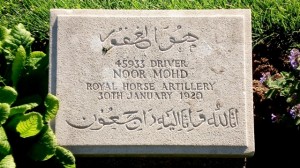
My own area of interest is India’s role in the Mesopotamian theatre. This was India’s main theatre of war and some 588,717 Indians were involved in the war effort there. When General Charles Townshend’s Sixth Division surrendered at Kut-el-Amara on 29th April 1916, a large number of Indians (one estimate put the number at around 10,000) were amongst those who were captured.
For some the journey hereon involved a hellish march across the desert to Ras al-’Ayn to work on the Constantinople – Baghdad railway. Others were sent across the Taurus Mountains to the POW camps at Afyon.
There is very little of the Mesopotamian Indian war experience that has survived or indeed been written about – David Omissi’s Indian Voices of the Great War: Soldier’s Letters, 1914 – 1918 and Santanu Das’ essay ‘Indians at home, Mesopotamia and France, 1914 – 1918’ in his edited volume Race, Empire and First World War Writing are two notable exceptions where the letters and memoirs of Indian soldiers who served in Mesopotamia are explored and discussed.
As Santanu Das has noted, the Indian war experience was not monolithic and just as Europeans, there were different wars and war experiences for Indians too. Trying to unearth soldiers’ experiences is more than an attempt at recovering wartime travelogues – “…the country here is absolutely uninhabited and desolate.”; “It rains very heavily and the entire surface of the land becomes a quagmire in which the slush is knee deep. When I used to march in this slush, I used to remember God!” It is also an important means to understand the experiences of these ordinary soldiers. What did they make of the place they were fighting in? Their enemy? Their own place in an imperial army? The loss of home? And of course, what did they make of religion at a time of war? Mesopotamia was a front that tested the loyalty of a number of Muslim Indian soldiers, who were confronted with the choice of fighting the troops of the Caliph or remaining loyal to the King. The 15th Lancers mutinied in Basrah in 1916, refusing to march against the Turks.
Other Muslim soldiers remained steadfastly loyal. At one point the Ottoman government decided to extend special treatment to a group of Muslim Indian POWs, taking them on a special tour of the Topkapi Palace and granting them a special audience with the Sultan. The British authorities were furious at this attempt to “get at” the Muslim soldiers. What the Muslim soldiers themselves made of it, we don’t know.
The fact that most of the Indian soldiers who fought in WWI came from economically less well-off backgrounds and were generally uneducated means that we have very little in terms of their textual memory – as memoirs, letters etc. – that still survives today, though there are fragments of their stories in the British archives and in the memoirs of British soldiers.
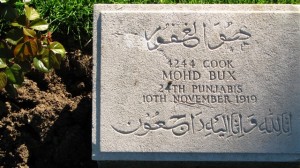
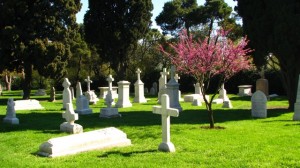
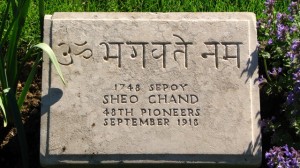
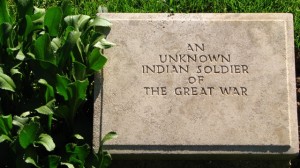
The language reforms that the Turkish Republic embarked on in 1928 has meant that any material in the Ottoman archives requires the knowledge of Ottoman Turkish to be accessible to the modern scholar (this always makes me sigh – as if learning Turkish was not torture enough!) Still apart from these textual sources, the memories of these soldiers still often survive in subtle, stubborn physical forms. In Istanbul, memorial stones can be found for a large number (around 170) of Indian POWs at the Haydarpasha English Cemetery.
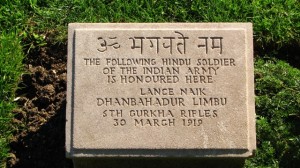
The cemetery itself was first built for the British Crimean war dead but also became home to many of Turkey’s British community and WWI POWs from the British Empire. The memorial stones remind us of the names of some of those Indians – sepoys, lance naiks, drivers, cooks – who were part of the British Indian army and who died in this country.
– Vedica Kant,
Istanbul, May 2012
A great insight into a neglected area of history. Thank you for the meticulous research Vedica and thank you Amitav for putting this on your blog.
Leela
The epitaph with Hindu symbols pulled few strings in my heart. Silent and numb for a few moments, this made me think seriously. These Indian soldiers went & died all the way in Istanbul fighting someone else’s war. Some 10,000 Indian soldiers died fighting on side of the queen in WW1. Each one is someones loved one and the pain of losing them only they know. RIP, my brethern.
I hope you saw my earlier post, with pictures from a cemetery near El Alamein?
best
Amitav
It reminded me of a visit to a cemetry of Indian soldiers in Forli (Italy), who had died in Europe in the second world war. I had written about it in Hindi at: http://jonakehsake.blogspot.it/2011/11/blog-post.html
Many thanks for the link sunil – I read the post with the greatest interest and have also tweeted the link. I hope you saw my earlier posts with excerpts from the memoir of an Indian POW in Italy?
Amitav
I had missed the post about memoirs of an Indian PoW in Italy – I need to read it. 🙂
The posts were on the following dates:
05/04/2012 An Indian POW in Italy: Part 4 of 4
04/04/2012 An Indian POW in Italy: Part 3 of 4
03/04/2012 An Indian POW in Italy: part 2 of 4
01/04/2012 An Indian POW in Italy: part 1 of 4
Amitav – I have just listened to the World Service Book Club with you discussing Shadow lines and heard you mention the Indian soldiers who were kept at the Pavilion in Brighton – hope you have seen this website http://www.black-history.org.uk/chattri.asp – which talks about the Chattri where there is a ceremony every year to commemorate the soldiers who died fighting for Britain in WW1. I lived in Brighton for a while and many of the local people were proud of the connection – I think some may have been descended from those “liaisons” you mentioned.
I also have good friends in Goa….
Sunanda
Thanks very much for this link Sunanda, and thanks also for letting me know about the broadcast.
very best
Amitav
The last picture of the Gurkha soldier Dhanbahadur Limbu is interesting, given the current quest for identity among Nepal’s ethnicities wherein the Limbus consider themselves Buddhist and not Hindu. More than 23,000 Nepalis died in WWI fighting for the British Army. Nepal’s population at that time was about 2 million, and the soldiers were all recruited from the Rai, Limbu, Gurung and Magar ethnic groups whose total popualtion must have been about 400,000, which means one in every five young men from these Nepali hill groups were killed in action. Another 22,000 were killed in WWII.
Really enjoyed listening to your mellifluous voice on the BBC discussion of Shadowlinnes, Amitav!
Thanks very much Kunda. Tried to find you on Twitter today with no luck – was hoping to get your views on the current Nepal crisis.
very best
Amitav
Dear Amitav. And I tried to find you in Brooklyn! Just got back to Kathmandu where everyone is going about as if nothing happened. I am on @kundadixit, and my email is in the ‘required’ field above.
Thanks. Let’s stay in touch.
all best
Amitav
Thanks Ms Kant for the wonderful post and also to Dr Ghosh for sharing it. The 1 700 000 Indians who participated (combat & non – combat) in the WWI consisted of a very unusual regiment the 49th Bengali Regiment.
The last thing one would expect a Bengal “is fight a war.” But it is what the Bengails did in Mesopotamia during WWI.
A memorial to the “49th Bengali” is located at the College Square’s eastern gate. Although strategically located the memorial is often covered by political posters and drying clothes and is very often over looked.
Sharing my Blog entry on the Bengali War Memorial http://rangandatta.wordpress.com/2011/12/25/bengali-war-memorial/
Thank you for this – it is fascinating!
A
Its nice to hear that Indian researchers are at last stumbling on the graves of Indian soldiers of the WWI.
I hope a few amongst them will realise that we have very few surviving biographies or researches done into the lives of painters,artists,musicians and sculptors of the yore..the reason is not far to seek..they never ever signed their works..that tradition continues to this day.many present day mural artists worth their salt do not sign when they paint a mural on a wall..murals or sculptures are like frozen music..if you think your are a hindusthani music lover, you can make out the difference …between Bade Ghalam Ali Khan and a Mallikarjun Mansoor..similarly,a connoisseur of paintings or murals is also expected to make the difference out between a MFHussien and a Souza without groping for the signature of the artist..
Now when will we know who was the lead artist at which site..in Ajanta.Ellora..Khajuraho, Mahabalipurm and so on.
Can we hope for a work like ‘My Name is Red ‘ on Indian artists and sculptors?
godspeed to you and vedica
A brief history of the 49th Bengalis has been written by Ashok Nath – see Peace and Security Review Vol.4 No. 7, 2011 published by the Bangladesh Institute of Peace and Security Studies (BIPSS). The unit did not cover itself with glory and served as Line of Communication troops. Lt.Gen. W R Marshall, the Army Commander who inspected the unit in Dec.1917, tried unavailingly to send the unit back to India. The College Square memorial mentioned by Rangan does not note the names of all the fallen, who appear to have died due to causes other than combat.
There is a book titled ‘Bangali Polton’ on 49th Bengalis. Few articles on this unit was published in Indian Military History Society magazine (Darbar) and Bangladesh Defence Journal.
thanks for letting me know – will look out for it.
A
In his memoir, General J N Chaudhuri writes of how the Bengal double Company was raised largely from the environs of Calcutta and he attended their send off. “It was a typically Bengali evening full of songs and speeches, emotion and elation, plus an abundance of sweets and snacks….Unfortunately, they went to Mesopotamia, WWI’s most ill managed campaign where they mutinied. And that was the end of Bengal’s double Company.”
Ms Kant’s post is interesting. Just like to add that the old Indian Army units have fair amount of historical details with regard to their units performance in various theatres of war. My own battalion, 110 Marathas, for eg, was a part of the Poona Division in WW1 and surrendered at Kut. The battalion was then reformed in India with men from the original unit who had remained behind along with fresh reinforcements and was subsequently deployed in Palestine. The total casualties(killed and wounded) in battalion (850 all ranks) during the war were 20 British officers, 18 Indian Officers and 1140 men,
Three Maratha battalions were in the Middle East and a Maratha Memorial Commemorating them stands outside the Peshwa’s Palace in Pune.It was unveiled in 1922.
Thank you very much for these details – I am sure they will be of interest to Vedica as well. Do you know of any memoirs written in Marathi by any of the soldiers who were in Mesopotamia in the 1st WW?
thanks
Amitav
Amitav,
Not aware of any such material from that time. Have however requested old unit personnel from that area to see if they can trace any stuff.
Regards
Brig Sinha, thank you for that. I have heard from various people now how a number of archival materials are still held with individual regiments, though the fact that there isn’t a central archive for military documents in India makes work for a researcher so much harder!
It is indeed sad that there are many Indians who choose to forget the Indian soldiers who fought in W W 1 and W W 2. It is even sadder that the Govt is so insensitive that hardly any effort is made to educate the Country about the bravery and sacrifices made by Indian soldiers thousands of miles away from their families,home,hearth and motherland, all for a cause and for something they believed in. Shameful also is the fact that it is the ‘other’ Nations who commemorate these battles where Indian blood was spilt. At the drop of a hat so many of our neta’s rush out on holiday junkets so that they can serve us better –and how many of them or even our Diplomats for that matter, have ever gone and saluted the graves of Indian soldiers in Italy, France, Belgium, Burma,Turkey, Iraq , Mesopotamia ?? I hang my head in shame when Indians say –‘it was not our war’–. Oh , you poor wretches , these soldiers were your blood : they were fellow Indians and they were your brothers. All I can say to such ‘ Indians’ —–
Breathes there the man, with soul so dead,
Who never to himself hath said,
This is my own, my native land!
Whose heart hath ne’er within him burn’d,
As home his footsteps he hath turn’d,
From wandering on a foreign strand!
If such there breathe, go, mark him well;
For him no Minstrel raptures swell;
High though his titles, proud his name,
Boundless his wealth as wish can claim;
A salute for Indian Soldiers:
http://papyrustony.blogspot.in/2012/06/indian-army-through-ages.html
and
http://papyrustony.blogspot.in/2012/02/st-martin-of-tours-pray-for-all-our.html
Hello friends I am from The Gurkha Veterans Foundation and we are participating with research groups about South Asian Veterans and Soldiers contributions in WW1 towards creating the exhibition and displays of their outstanding achievements: the Project Title is
” Far From The Western Front ”
I am looking for Nepal as Allied and their men and women participated in WW1 and also supply human resources to the British Empire at their request to Nepal Government : still researching for any account on these great warriors of South Asian descent and origin
Please email it to me: padma42@aol.com
Thank you very much for your patience and help and indeed support to present rightful history and stories of Unknown Heroes.
Dear Sir,
Is there any Bengali ( In today’s Bangladesh i am talking about) who fought in W W 1 and W W 2. Can you sir, name books on Bengali participation on this 2 great war.
Regards